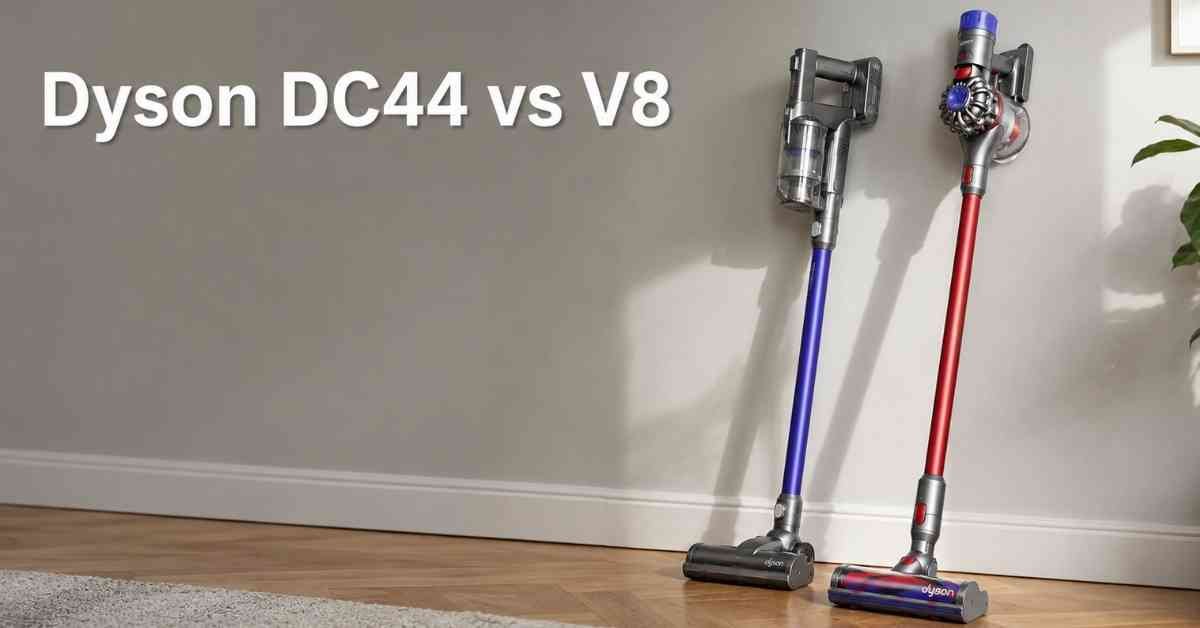
Looking at the Dyson DC44 vs V8 is like comparing an old reliable truck to a modern daily driver. Both of these stick vacuums have a loyal following, but they serve very different households today. I spent weeks using both as my main cordless vacuum to see how they handle real-life messes, dog hair, and daily crumb spills.
If you just want a quick garage vacuum, the older model might tempt you. But if you need serious suction power for a whole apartment, the gap in battery runtime becomes obvious very fast. Let’s dive into what actually happens when you compare the Dyson DC44 vs V8 side by side.
Side-by-Side Specs Comparison
Before getting into the daily dirt, let’s look at the raw numbers. Here is how the basic hardware stacks up between these two models.
| Feature | Dyson DC44 | Dyson V8 |
| Suction (AW) | 65 AW | 115 AW |
| Weight | 5.07 lbs | 5.64 lbs |
| Battery Runtime | Up to 20 mins | Up to 40 mins |
| Charge Time | 5.5 hours | 5 hours |
| Dustbin Size | 0.35 Liters | 0.54 Liters |
| Filtration | Washable filter | Whole-machine HEPA |
Specs only tell part of the story, though. The real test is how that battery and motor perform when you are rushing to clean up before guests arrive.
Unboxing and First Impressions
Pulling the V8 out of the box feels like getting a premium gadget. The wand clicks together smoothly, and the wall mount dock is easy to set up. It feels balanced in the hand, though slightly heavier than the older model.
The DC44 feels noticeably more raw and utilitarian by comparison. It is a very lightweight design, making it easy to swing around. However, the first time I powered it on, the motor whine sounded much higher-pitched. The trigger on the older model also felt a bit stiff right out of the box.
Cleaning Performance
You need a vacuum that actually picks up the mess on the first pass. Here is how they handled different floors in my home.
On Hardwood Floors
The V8 glides over hardwood floors and picks up cereal without snowplowing it forward. The soft roller head is a game-changer for dusting bare floors. The DC44 does okay, but it tends to scatter larger crumbs before sucking them up.
On Low-Pile Carpet
Both models handle low-pile rugs well enough for daily maintenance. The DC44 agitated the fibers well but lacked the deep suction for embedded dirt. The V8 easily pulled up fine sand that the older model left behind.
On High-Pile or Thick Carpet
You will quickly see the limits of a stick vacuum on thick carpets. The DC44 bogged down and the brush roll sometimes stopped spinning on my thickest rug. The V8 pushed through much better, though it did drain the battery fast on max mode.
Pet Hair
My dog sheds constantly, filling the dustbin fast. The V8 swallowed clumps of fur easily without wrapping tightly around the main roller. The DC44 got the surface hair, but I had to cut hair off the brush roll after just two uses.
Fine Dust and Allergens
This is where the newer motor shines. The V8 pulls a surprising amount of fine, powdery dust out of seemingly clean rugs. The DC44 mostly just gets the visible surface debris.
Edges and Corners
The V8 has great edge cleaning, pulling dust right from the baseboards. The DC44 struggled a bit near the edges of the kitchen cabinets. I had to use the crevice tool much more often with the older model.
Suction Power and Motor
You can actually feel the difference in motor generations when you pull the trigger. The V8 offers a strong, smooth pull that feels consistent.
The DC44 has decent grab for quick spills, but it lacks that deep-cleaning muscle. When the dustbin gets about half full, the DC44’s suction drops noticeably. The V8 holds steady suction power right until the battery dies.
Filtration and Air Quality
If you have allergies, filtration matters just as much as suction power. The V8 features full HEPA filtration that seals in allergens.
The DC44 just uses a basic washable filter. When vacuuming fine baking soda, I noticed a slight dusty smell from the DC44 exhaust. The V8 left the air feeling totally clean.
Battery Life and Runtime
Battery anxiety is a real thing with any cordless vacuum. When testing the Dyson DC44 vs V8, battery life was the biggest dealbreaker.
The V8 claims 40 minutes, but with the motorized floor head, it is closer to 25 minutes. The DC44 taps out around 15 minutes of real-world use.
If you switch either machine to max mode, the battery dies in under 8 minutes. I constantly found the DC44 dead mid-room because I forgot to charge it the day before. You can definitely feel the suction drop in the last few minutes of the DC44’s battery.
Design and Build Quality
Dyson has completely refined how their vacuums feel in the hand over the years. Here is a quick look at the build differences.
| Feature | Dyson DC44 | Dyson V8 |
| Body Material | Hard plastic | Premium polycarbonate |
| Handle Grip | Basic plastic | Ergonomic grip |
| Overall Feel | Utilitarian | Refined and solid |
The V8 feels much sturdier during daily use. The hygienic dirt ejector on the V8 is a massive upgrade over the messy trap door on the older model.
Noise Level
Nobody wants a vacuum that sounds like a jet engine. The V8 is surprisingly quiet on the normal eco mode. It has a muffled, low hum that doesn’t completely drown out the TV.
The DC44 is much louder and has a high-pitched whine. You definitely cannot hold a conversation while running it. On max mode, both vacuums are quite loud, but the older model vibrates more in your hand.
Attachments and Accessories
The tools you get can make or break the convertible handheld experience. Let’s see what comes with each machine.
| Attachment | Dyson DC44 | Dyson V8 |
| Crevice Tool | Standard plastic | Quick-release plastic |
| Motorized Tool | Mini brush bar | Mini motorized tool |
| Docking | Wall mount | Wall mount dock |
The quick-release red buttons on the V8 attachments are amazing. On the DC44, the friction-fit attachments occasionally popped off the wand when I pulled it back too fast.
Ease of Use and Maintenance
Keeping your vacuum clean shouldn’t be a chore. Both require regular filter washing and brush roll clearing.
| Task | Dyson DC44 | Dyson V8 |
| Emptying Bin | Messy, requires hands | Pull lever, dirt falls out |
| Washing Filter | Rinse once a month | Rinse once a month |
| Clearing Roller | Coin slot release | Coin slot release |
I vastly prefer maintaining the V8. The dust bin on the older model is so small that it fills up with pet hair constantly, and you have to reach in to pull out stuck dust.
Real-Life Daily Use Experience
My morning routine involves a quick lap around the kitchen and living room. The V8 is an absolute joy for this because I never worry about the battery dying. It easily handles one floor of my house.
Using the DC44 gave me constant battery anxiety. I would race through the rooms hoping the suction wouldn’t drop. It is still a great grab-and-go tool for the car, but it frustrates me for full-room cleaning.
Price and Value for Money
Finding a brand new DC44 is tough these days, so you are mostly looking at refurbished models. They are very cheap, but you often need to buy a replacement battery right away.
The V8 is still sold new and frequently goes on sale. While it costs more upfront, the included HEPA filter and larger battery make it a much better long-term investment. The price gap is entirely justified by the performance.
How It Compares to Similar Vacuums
It helps to see how these models stack up against the broader cordless vacuum market.
Dyson V10
The V10 shifted the bin sideways and increased the dustbin capacity significantly. It offers better battery life than the V8, but it is also heavier and more expensive.
Shark Stratos Cordless
Shark offers incredible suction power and dual brush rolls that handle hair better than the older Dysons. However, the V8 still feels slightly lighter and more maneuverable around tight furniture.
Dyson V7
The V7 is basically the middle ground between the two models we are testing. It has less runtime than the V8 but shares the same improved dustbin design over the DC44.
Who Should Buy Which?
Depending on your living situation, one of these will definitely suit you better.
- Buy Dyson V8 if: You have pets, need HEPA filtration, and want enough battery to clean a standard apartment in one go.
- Buy Dyson DC44 if: You can find it super cheap used, and you only need a secondary vacuum for quick spills or cleaning the car.
- Consider Neither If: You have a massive home with deep, high-pile carpets in every room. You will want a corded upright instead.
Long-Term Durability
After extensive use, stick vacuums always show some wear and tear. The clear plastic dustbins on both models will get scratched and cloudy from sucking up hard debris.
The biggest issue with the DC44 over time is the battery pack losing its ability to hold a charge. The V8 motor holds up incredibly well, though the soft roller head needs regular washing. Expect the V8 to outlast the older model significantly.
Energy Efficiency: Dyson DC44 vs V8
Since both are cordless, energy efficiency is really about how well they manage battery draw. The newer model manages its power delivery much smarter.
The V8 doesn’t get overly hot during a 20-minute session on standard mode. The older model tends to warm up near the handle if you hold the trigger down too long. Neither will spike your electricity bill, but the V8 gets much more work done per charge.
Final Verdict
When looking at the Dyson DC44 vs V8, there is a clear winner for everyday home use. The V8 simply outclasses the older model in suction, battery runtime, and overall ease of use. The hygienic bin emptying alone makes it worth the upgrade.
If you are on a very tight budget and just need a quick spot cleaner, a used DC44 can still do the trick. However, for a reliable daily driver that handles pet hair and protects your air quality, the V8 remains a fantastic choice.