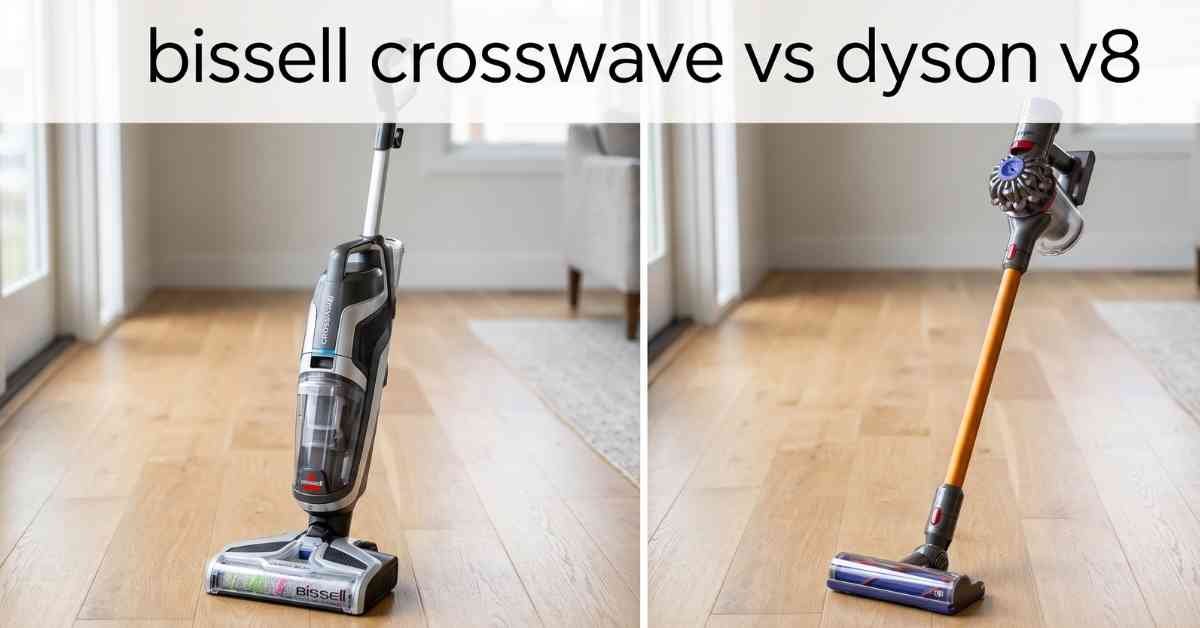
Testing the bissell crosswave vs dyson v8 taught me a lot about how different two cleaners can be. I used both of these models in my home for weeks. I wanted to see which cordless vacuum truly handles daily life. The Dyson fits people who want a quick grab-and-go stick vacuum. The Bissell aims at folks needing to wash hard floors while they sweep.
Both machines promise to make cleaning fast and easy. But they serve very different needs. If your home has mostly thick carpets, one of these will fail you. I noticed plenty of small annoyances with both units. By the end of this guide, you will know exactly which one fits your rooms and your budget.
Side-by-Side Specs Comparison
Looking at the numbers helps you see the real differences. Here is how these two models match up on paper before hitting the floors.
| Feature | Bissell CrossWave | Dyson V8 |
| Suction (Pa/AW) | Not Listed | 115 AW |
| Weight | 10.5 lbs | 5.8 lbs |
| Battery Runtime | Up to 30 min | Up to 40 min |
| Charge Time | 4 hours | 5 hours |
| Filtration | Standard washable | HEPA filtration |
| Dustbin Size | 0.62 L (Dirty Tank) | 0.54 L |
| Warranty | 2 Years | 2 Years |
Those numbers only tell half the story. The real test happens when you spill cereal or track in muddy footprints.
Unboxing and First Impressions
Taking the Dyson out of the box felt like unpacking a fun gadget. The parts snap together with a loud, satisfying click. It feels incredibly light in your hand right away. I could easily lift it above my head to reach cobwebs. Setting up the wall mount dock took me about ten minutes with a drill.
The Bissell was a completely different experience altogether. The box was heavy, and the machine felt very bulky. You have to snap the handle in place and fill the water tank first. It felt much more like a traditional mop bucket mixed with an upright machine. When I first turned it on, the motor sounded loud and rough.
Cleaning Performance
You buy a vacuum to clean up daily messes quickly. Here is how both machines handled my house.
On Hardwood Floors
The Bissell shines brightly on sealed wood and tile floors. It washes and sucks up dirty water at the exact same time. The Dyson picks up dry crumbs and fine dust very easily. But the Dyson cannot handle wet spills or muddy paw prints at all.
On Low-Pile Carpet
The Dyson V8 digs deep into thin carpets to pull out hidden dust. The brush roll grooms the fibers nicely as you push it. The Bissell can refresh flat area rugs with its gentle wash cycle. However, the Bissell leaves those rugs feeling slightly damp for an hour.
On High-Pile or Thick Carpet
The Dyson struggles a bit to push through thick rugs, but the suction remains strong. The motor head pulls up trapped dirt very well. The Bissell completely fails on thick carpets and shaggy rugs. It is simply not designed for deep, fluffy surfaces.
Pet Hair
The Dyson pulls pet fur out of carpets like a powerful magnet. The hair does wrap around the brush roll sometimes, which is annoying. The Bissell handles wet messes and fur on hard floors perfectly. But emptying wet pet hair from the Bissell tank is totally gross.
Fine Dust and Allergens
The Dyson features a sealed system that traps fine dust inside the bin. You never see the dust blow back into the air you breathe. The Bissell uses water to trap dust, which works surprisingly great. You just have to clean the dirty water tank right away to avoid smells.
Edges and Corners
The Dyson gets right up to the baseboards easily and cleans them. The slim head reaches under kitchen cabinets without bumping them hard. The Bissell leaves a small gap of unwashed floor near the walls. It also feels too chunky to slide under low sofas or beds.
Suction Power and Motor
Motor power makes a huge difference in how clean your floors feel. Both machines pack a very strong punch in different ways.
The Dyson features a high-speed motor that creates amazing suction power. You can feel it pulling against the floor when you use max mode. But the max mode drains the battery in just seven short minutes. Regular eco mode works totally fine for simple daily dust.
The Bissell does not rely entirely on pure suction power to clean. It uses a spinning wet brush roll to scrub the floor hard. It pulls the dirty water up effectively without leaving puddles. I never felt a drop in suction, even as the dirty tank filled up completely.
Filtration and Air Quality
Keeping the air clean matters just as much as having clean floors. These two handle allergen capture very differently.
The Dyson V8 includes top-tier HEPA filtration built right in. It traps tiny allergen particles safely inside the clear bin. The filters are washable, saving you money on expensive replacement costs.
The Bissell uses a basic washable filter to protect the main motor. Because it is a wet vacuum, it does not blow dusty air around the room. But if you forget to clean the tank, it will smell like dirty water tomorrow.
Battery Life and Runtime
Cordless vacuums live and die by their built-in batteries. I experienced serious battery anxiety with both of these units.
The Dyson claims up to 40 minutes of total battery runtime. In reality, I got about 25 minutes using the motorized floor head. I found it dead in the morning twice because I forgot to dock it properly. It takes five very long hours to recharge completely from zero.
The Bissell battery lasts around 25 to 30 minutes on a full charge. That gives you enough time to wash a kitchen and large living room. Once the battery dies mid-room, you are stuck waiting four full hours. You cannot swap the battery out on either machine quickly.
Design and Build Quality
How a machine feels in your hand changes how often you actually use it. Comfort matters for daily cleaning.
| Feature | Bissell CrossWave | Dyson V8 |
| Body Material | Thick heavy plastic | Clear and gray plastic |
| Handle or Grip | Top loop handle | Pistol grip with trigger |
| Stability During Use | Stands up on its own | Must be leaned against wall |
| Button Quality | Clicky top buttons | Spring-loaded finger trigger |
| Storage Footprint | Floor parking tray | Wall mount dock |
| Overall Feel | Heavy and sturdy | Lightweight and agile |
The Dyson feels much better for a quick daily clean. Its lightweight design makes it easy to grab for minor kitchen spills. The Bissell feels heavy and tiring to push around for a long time.
Noise Level
Loud vacuums ruin the peace and quiet of a nice home. Both of these machines make their presence known right away.
The Dyson has a high-pitched whine that sounds like a power drill. On normal mode, you can still hear the television over it easily. When you switch to max mode, the noise jumps up significantly. It is loud enough to interrupt a nearby conversation instantly.
The Bissell sounds lower and much louder, like a traditional shop vacuum. You can feel the vibration through the handle as the wet brush spins. It is definitely not something you want to use while someone is sleeping nearby.
Attachments and Accessories
Having the right tool for the job saves you a lot of time. Extra nozzles make a big difference for tight spots.
| Attachment | Bissell CrossWave | Dyson V8 |
| Crevice Tool | None | Yes |
| Mini Motorized Brush | None | Yes |
| Soft Roller Head | Built-in wet roll | Fluffy head included |
| Extension Wand | None | Yes |
| Wall Mount / Dock | Floor tray only | Yes |
| Handheld Mode | No | Yes |
The Dyson wins easily when it comes to helpful extra tools. Converting it to a convertible handheld vacuum takes just two seconds. The Bissell does not convert into a smaller unit at all. It is strictly a floor cleaner with absolutely no extra attachments.
Ease of Use and Maintenance
Cleaning the vacuum itself is easily the worst part of daily chores. This is where the two models feel totally opposite.
| Task | Bissell CrossWave | Dyson V8 |
| Dustbin Emptying | Pour dirty water out | Pull lever to drop dirt |
| Brush Roll Cleaning | Self-clean tray cycle | Coin-turn unlock |
| Filter Washing | Rinse and air dry | Rinse and air dry |
| Dishwasher Safe Parts | No | No |
| Deep Clean Ease | Tedious tank washing | Simple wipe down |
| Odor After Use | High if not cleaned | None |
The Dyson is incredibly simple to empty and maintain week after week. The Bissell demands serious maintenance time after every single use. If you do not wash the Bissell parts, they will smell terrible. Emptying the Bissell sludge is my absolute least favorite chore.
Real-Life Daily Use Experience
Using these tools every single day revealed their true colors fast. They fit into a home routine very differently.
My morning routine with the Dyson is incredibly fast and painless. I grab it off the wall mount dock, hit the kitchen rugs, and put it right back. The dustbin fills up way faster than expected with thick pet hair. I had an attachment pop off the wand mid-use once, but it snapped right back on.
The Bissell requires a whole annoying setup process before you start. You have to fill the clean tank with warm water and special formula. Then you clean the floor, which looks absolutely amazing afterward. But then you must spend ten minutes cleaning the dirty machine itself. I only reach for the Bissell on serious deep cleaning days.
Price and Value for Money
Budget is always the biggest factor when buying new floor care items. Both models require a decent upfront investment.
The Dyson V8 usually costs around 350 to 450 dollars brand new. You can often find it on sale during big holiday savings events. Since the filters are washable, your long-term costs stay very low. I think the price is fully justified by how much you will actually use it.
The Bissell CrossWave cordless models run between 300 and 400 dollars roughly. You have to keep buying their special cleaning solution, which adds up fast. You also need to buy new brush rolls every six months to keep it fresh. It is fairly expensive to maintain over a two-year period.
| Cost Factor | Bissell CrossWave | Dyson V8 |
| Initial Retail Price | Around $350 | Around $400 |
| Filter Replacement | $15 annually | $0 |
| Solution Cost | $20 per bottle | $0 |
| Total 2-Year Cost | Much Higher | Very Low |
| Best Value Use Case | Hard floor homes | Mixed floor homes |
How It Compares to Similar Vacuums
Sometimes you need to look at other options to know for sure. There are plenty of rivals on the market today.
Tineco Floor One S3
The Tineco is another popular wet and dry vacuum like the Bissell.
It features a smart sensor that adjusts suction power automatically on messes. The Tineco pulls itself forward slightly, making it feel lighter than the Bissell. But the Tineco has a smaller dirty water tank that needs constant emptying during large jobs.
Shark Stratos Cordless
The Shark Stratos is a very direct rival to the Dyson V8.
It features amazing suction power and a built-in odor neutralizer pod. The Shark wand bends in the middle to easily reach under very low furniture. However, the Shark feels much heavier in the hand than the lightweight Dyson design.
Who Should Buy Which?
Making the final choice depends entirely on your daily floor cleaning habits.
Buy Bissell CrossWave if:
- You have mostly hard floors like tile or sealed wood
- You want to mop and vacuum in one single easy step
- You clean up wet spills like cereal or muddy prints often
Buy Dyson V8 if:
- You want a lightweight design for quick daily dry messes
- You need a convertible handheld vacuum for the family car
- You have a fair mix of hard floors and thick carpets
Consider Neither If:
- You have a massive house requiring a 60-minute battery runtime
- You hate emptying small bins and need a large bagged unit
Long-Term Durability
Nobody wants to buy a brand new vacuum every single year. You want a machine that handles abuse well.
The Dyson V8 holds up well, but the battery life drops noticeably over time. After a year, max mode might only last four minutes before dying. The plastic bin can get scratched up badly from vacuuming hard dirt and pebbles. The attachment fits can get a bit loose after clicking them in and out daily.
The Bissell motor stays strong, but the rubber gaskets degrade if left sitting wet. The plastic water tanks will turn cloudy after months of holding dirty water. You must replace the brush roll often, or it just pushes sticky dirt around. Expect both of these machines to last about three to four years with good care.
Energy Efficiency: bissell crosswave vs dyson v8
Saving power at home is always a really nice bonus feature. Cordless units generally excel at this task.
Both of these vacuums are highly energy efficient for normal home use. They use much less electricity than giant heavy corded vacuums do. The Dyson pulls power efficiently and shuts off immediately when you release the trigger. This trigger saves a lot of battery runtime during a normal cleaning session.
The Bissell pulls more power constantly because it spins a heavy wet brush. It also heats up near the motor during a full 30-minute deep cleaning session. Neither machine will cause a spike in your home energy bill at all. But the Dyson is slightly better for quick, highly efficient power bursts.
Final Verdict
Choosing a clear winner between the bissell crosswave vs dyson v8 comes down to your floors. The Dyson V8 is the absolute winner for everyday dry messes. Its lightweight design and strong Pa suction make it incredibly versatile for any room.
The Bissell is a fantastic specialty tool for hard floors only. It does an amazing job scrubbing sticky spills, but the daily cleanup is annoying. If I could only keep one, I would definitely choose the Dyson V8. It simply fits a normal daily cleaning routine much better with less hassle.